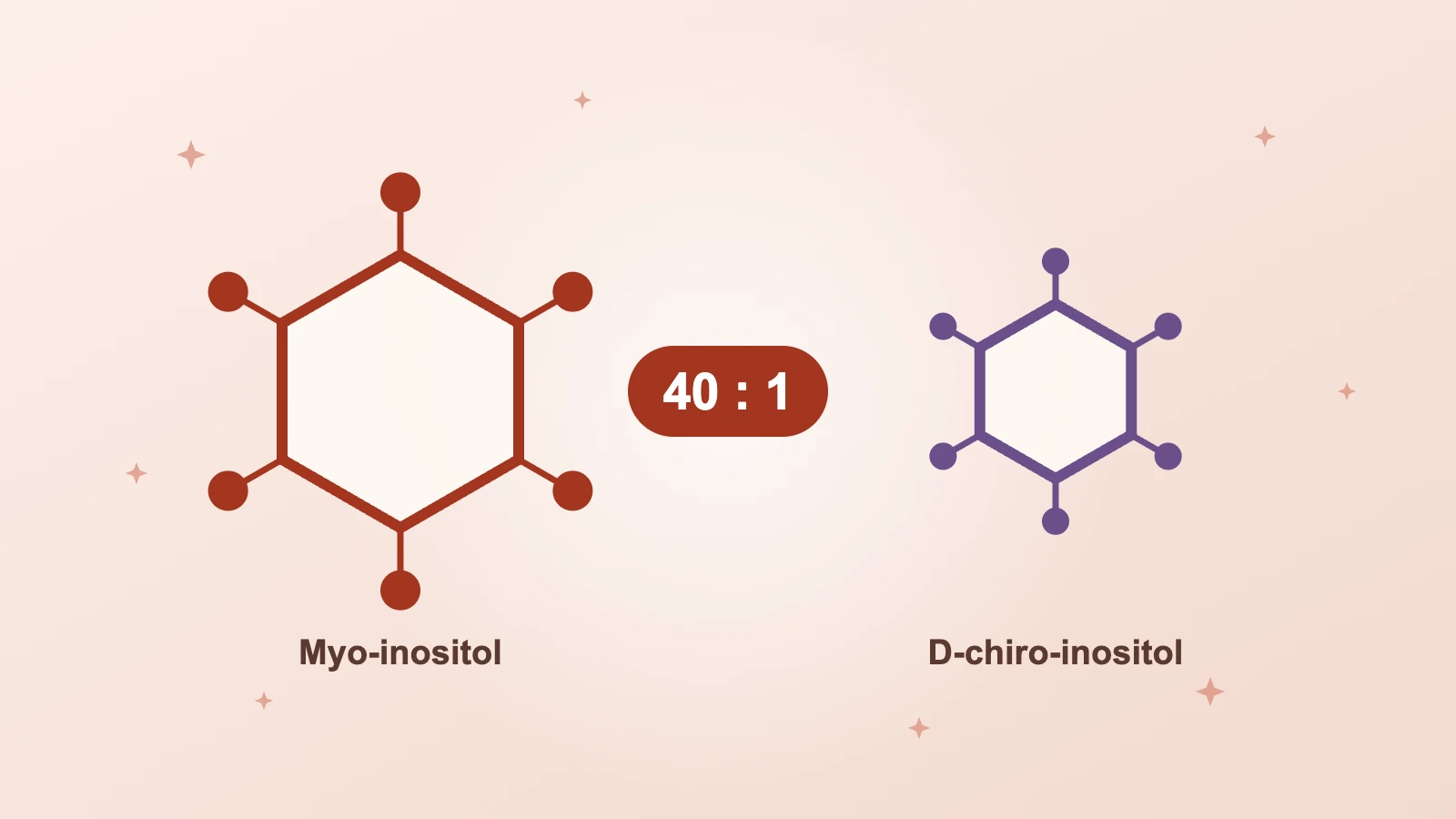
Myo-inositol and D-chiro-inositol are two forms of the same naturally occurring compound. Many women’s wellness supplements for PCOS (now also called PMOS) combine them in a 40:1 ratio. Here is what the two forms are, where the 40:1 figure comes from, what research has and has not shown, and how to read the numbers on a label.
Key facts
- What they are: two forms (stereoisomers) of inositol, a compound the body makes and also gets from foods such as fruit, beans, grains and nuts.
- Why 40:1: it is roughly the ratio of myo-inositol to D-chiro-inositol measured in human blood plasma.
- What the evidence says: small trials have studied inositols in women with PCOS, mostly for metabolic and cycle-related measures. The 2023 international PCOS guideline describes inositol as experimental, with emerging but limited evidence.
- Not a treatment: inositol is not a replacement for medical care or prescribed medicine.
- On a label: 2,000 mg of myo-inositol with 50 mg of D-chiro-inositol is a 40:1 ratio.
What is inositol?
Inositol is a sugar-alcohol compound found in every cell of the body. It works as a building block for messenger molecules that help cells respond to hormones, including insulin. Your body makes inositol, and a typical diet also provides some, especially from citrus fruit, beans, whole grains and nuts.
There are nine forms of inositol. Two are discussed most often in women’s health:
- Myo-inositol (MI) is the most common form in the body. It is involved in how cells respond to insulin and to follicle-stimulating hormone (FSH), one of the hormones that guides egg development in the ovary.
- D-chiro-inositol (DCI) is made from myo-inositol by an enzyme in the body. It is involved in how insulin signals cells to store glucose.
Different tissues keep different balances of the two. The ovary normally holds much more myo-inositol than D-chiro-inositol, while tissues that store glucose, such as muscle and liver, rely more on D-chiro-inositol.
Why is inositol discussed in PCOS?
Many women with PCOS have some degree of insulin resistance, meaning cells respond less readily to insulin. Researchers have proposed that the conversion of myo-inositol into D-chiro-inositol may be altered in PCOS, which could leave the ovary with less myo-inositol than it normally holds. That theory is the reason inositols have been studied in PCOS. It is a hypothesis under study, not a settled explanation of the condition.
If you are new to the condition itself, our guide to PCOS (PMOS) symptoms, diagnosis and when to see a doctor explains the basics first.
Where does the 40:1 ratio come from?
In healthy people, blood plasma contains roughly 40 parts myo-inositol for every 1 part D-chiro-inositol. Supplements using a 40:1 ratio are designed to mirror that physiological balance rather than to deliver a large amount of D-chiro-inositol on its own.
The ratio became widely used after Italian researchers compared several MI:DCI combinations in women with PCOS. In their 2019 study, the 40:1 combination was associated with better results on ovulation and some hormonal measures than the other ratios they tested. It was a relatively small study, and other research groups have not studied every ratio head to head, so it is fair to describe 40:1 as the best-studied combination rather than a proven optimum.
Why more D-chiro-inositol is not “stronger”
Some researchers have raised the concern that very high doses of D-chiro-inositol on their own may not suit the ovary, which normally relies on myo-inositol. This is one reason combinations close to the body’s own ratio are preferred over D-chiro-inositol alone. If you are comparing products, a higher D-chiro-inositol number is not automatically better.
What does the research actually show?
Most inositol studies in PCOS are small, short (often three to six months) and use different doses and combinations, which makes them hard to compare. With that caveat, trials have looked at:
- Metabolic measures such as fasting insulin and insulin resistance scores, where some studies have reported improvements.
- Cycle regularity and ovulation, with mixed results.
- Androgen levels, acne and excess hair, where evidence is limited.
- Weight, where the evidence does not show a meaningful effect.
The 2023 International Evidence-based Guideline for PCOS reviewed this evidence. It concluded that inositol, in any form, should be considered an experimental therapy: it may have metabolic benefits, but evidence for effects on ovulation, hair growth or weight is limited. The guideline also notes that side effects are generally mild, and that women who choose to take inositol should tell their doctor and understand the uncertainty.
That is a balanced place to start. Inositol is one of the better-studied nutritional ingredients in PCOS, but it is not a cure and it does not replace the foundations of care: regular movement, balanced meals, sleep, and any treatment your doctor recommends.
How to read inositol amounts on a label
To check the ratio yourself, divide the myo-inositol amount by the D-chiro-inositol amount in the same serving.
- Find both amounts per servingLook for milligrams (mg) of each form, not just “inositol”. A label that lists only “inositol blend” does not tell you the ratio.
- Divide one by the other2,000 mg myo-inositol ÷ 50 mg D-chiro-inositol = 40. That is a 40:1 ratio. 1,100 mg ÷ 27.6 mg is also about 40:1.
- Check the daily totalStudies have commonly used around 2,000–4,000 mg of myo-inositol a day. Check how many servings a day the label directs, and do not exceed it.
- Look at everything else in the servingCombined formulas include other ingredients. Each one is a reason to check for interactions with your medicines.
- Check the manufacturer detailsIn India, a food supplement label should show an FSSAI licence number and the manufacturer’s name and address. Our article on how to read a supplement label covers this step by step.
Is inositol safe?
In studies, inositol has generally been well tolerated at the doses used. The most commonly reported side effects are mild stomach upset, nausea or loose stools, usually at higher doses. Even so:
- Speak to your doctor first if you are pregnant, trying to conceive, or breastfeeding.
- Tell your doctor if you take medicine for diabetes or blood sugar, since inositol is studied for its effect on insulin.
- Do not stop or change any prescribed medicine, such as metformin or hormonal treatment, because you have started a supplement.
How SophEva uses myo-inositol and D-chiro-inositol
SophEva’s morning sachet, Sunrise Sync, contains 2,000 mg of myo-inositol and 50 mg of D-chiro-inositol per serving, a 40:1 ratio, alongside other ingredients listed on our ingredients page. It is part of a daily routine that also includes an evening sachet, seed cycling mixes, guided movement and a habit book.
To be clear about what this means: the research described above studied inositol itself, not the complete SophEva formula. SophEva is a food supplement for daily wellness, not a medicine, and it is not intended to diagnose, treat or cure any condition.
Frequently asked questions
What is the difference between myo-inositol and D-chiro-inositol?
They are two forms of inositol. Myo-inositol is the most common form in the body and is involved in insulin and FSH signalling. D-chiro-inositol is made from myo-inositol and is involved in glucose storage. The body keeps them in different balances in different tissues.
Why is the ratio 40:1?
It is roughly the ratio of the two forms found in human blood plasma. A 2019 study comparing several ratios in women with PCOS found the best results with 40:1, though the study was small.
Can I take myo-inositol alone?
Many studies used myo-inositol alone. Whether a combination or a single form suits you is a question to discuss with your doctor.
How long do studies run?
Most studies lasted three to six months. Results in research groups do not predict what an individual will experience.
Does inositol help with weight loss?
The 2023 international guideline found the evidence for weight effects to be limited. Inositol should not be relied on for weight management.
Is inositol a replacement for metformin?
No. Do not stop or replace any prescribed medicine without speaking to your doctor.
Keep reading
PCOS (PMOS): the complete guide
PCOS vs PCOD vs PMOS: is there a difference?
Seed cycling: how it works and what the evidence says
Want a routine you can actually keep?
The SophEva Rituals Kit brings it together: a morning and an evening sachet, seed cycling mixes, guided yoga and a 90-day habit book, with a free doctor consultation.
Sources
- International Evidence-based Guideline for the Assessment and Management of PCOS, 2023 (Monash University / NHMRC)
- Nordio M, Basciani S, Camajani E. The 40:1 myo-inositol/D-chiro-inositol plasma ratio is able to restore ovulation in PCOS patients: comparison with other ratios. Eur Rev Med Pharmacol Sci, 2019.
- Facchinetti F, et al. Results from the International Consensus Conference on myo-inositol and D-chiro-inositol in obstetrics and gynecology: the link between metabolic syndrome and PCOS. Eur J Obstet Gynecol Reprod Biol, 2015.
- World Health Organization: Polycystic ovary syndrome fact sheet
Disclaimer: This information is for educational purposes only and does not constitute medical advice. Always consult with a healthcare professional before starting any new supplement or lifestyle regimen.